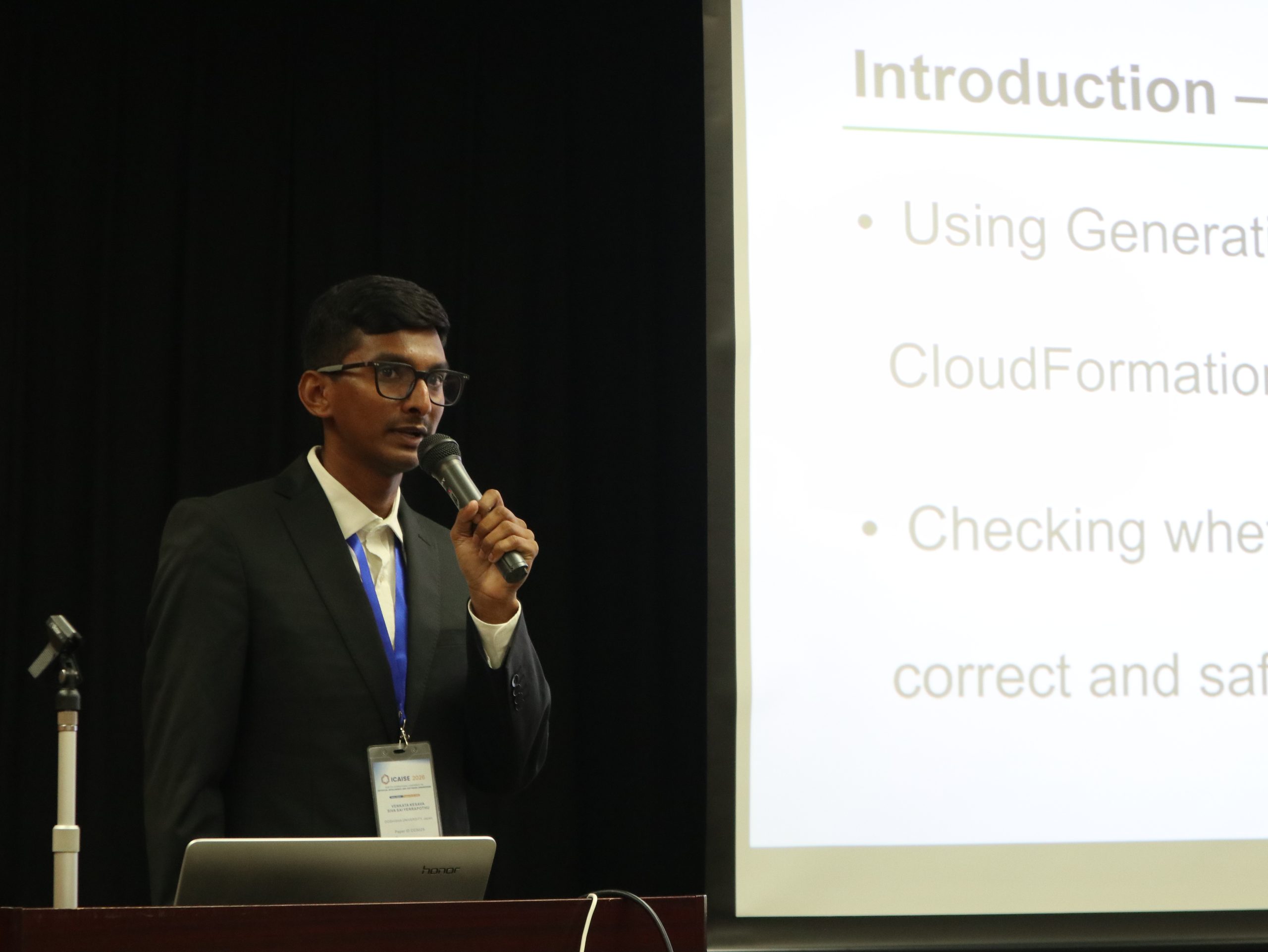
Hello! I’m Yerrapothu Venkata Kesava Siva Sai, a second-year Master’s (M2) student at Doshisha University. I recently had the opportunity to participate in ICAISE 2026, the International Conference on AI and Software Engineering, held at the University of Electro-Communications (UEC), Chofu-shi, Tokyo, Japan, from Friday, August 21st to Sunday, August 23rd, 2026.
The symposium brought together researchers from Japan and abroad — including participants from Canada, India, Malaysia, Kazakhstan, and Bangladesh — working on cutting-edge topics in artificial intelligence and software engineering, many of which aligned closely with my own field of study. I was honored to present my research titled:
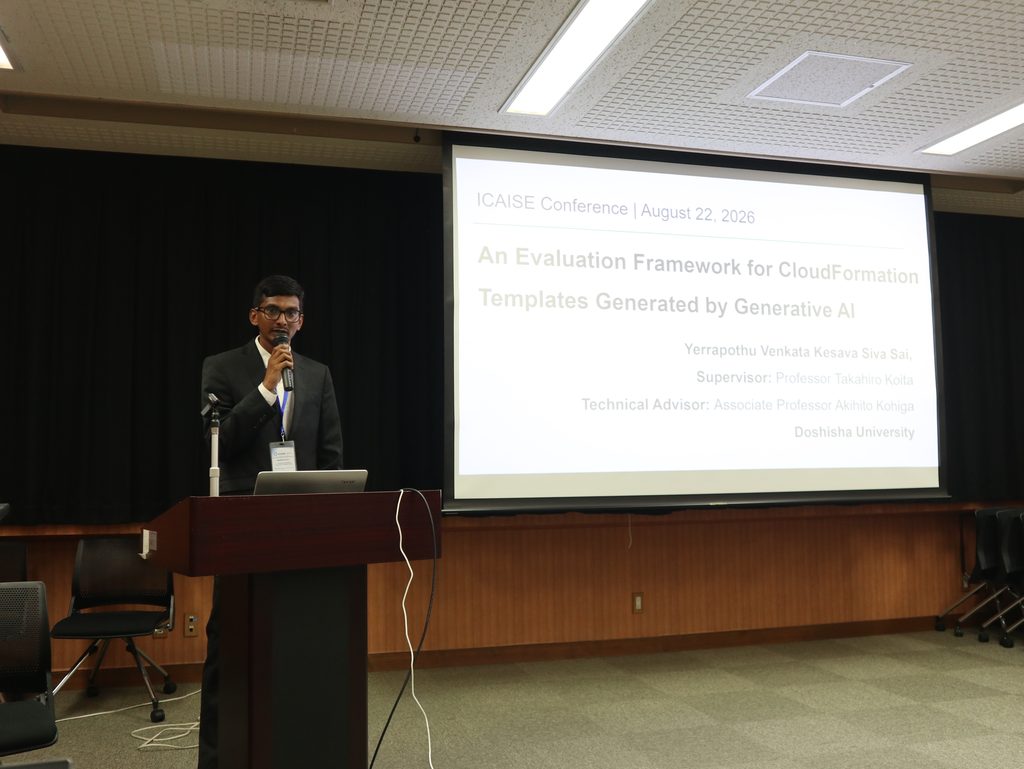
“An Evaluation Framework for CloudFormation Templates Generated by Generative AI” (Paper ID: CC5025)
Venue and Presentation
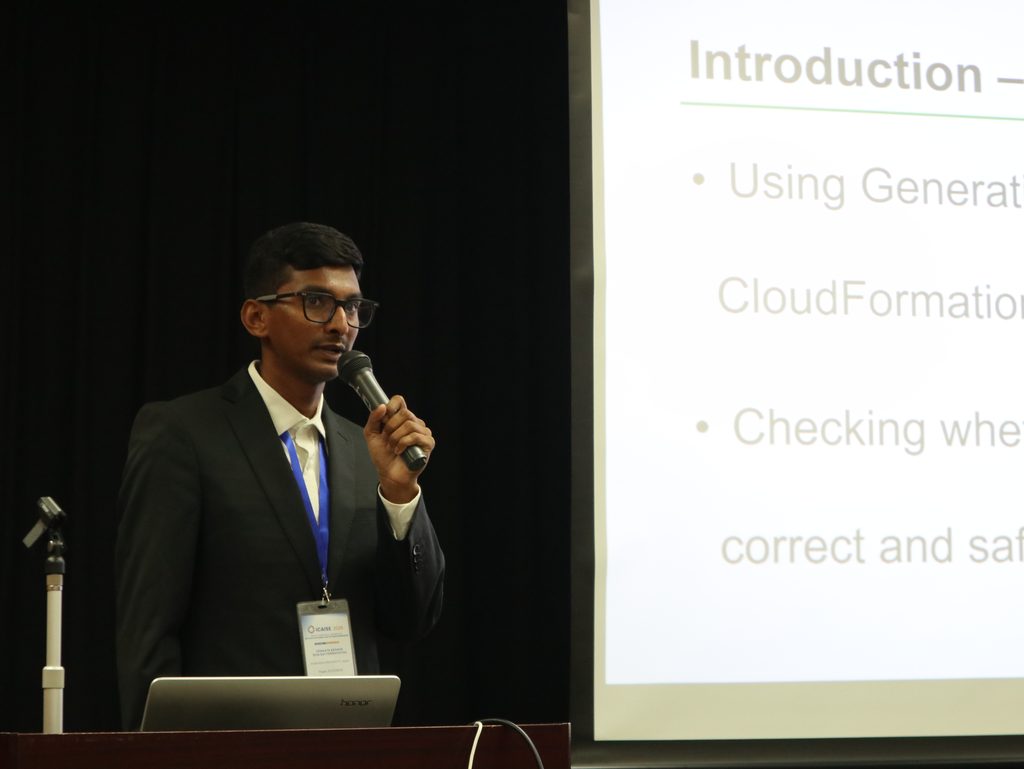
My presentation took place on Day 2 (August 22nd) in the afternoon session at the Large Conference Room, UEC Chofu campus, as part of the parallel session on generative AI-driven methods for program synthesis, test generation, and formal verification.
About the Research
In my study, I proposed and evaluated an automated three-gate validation and self-healing framework for AI-generated AWS CloudFormation templates. The framework combines static analysis (cfn-lint), security scanning (cfn-nag), custom best-practice checks, and runtime simulation using LocalStack, paired with an iterative correction loop powered by the Claude API.
Across 116 unique CloudFormation templates spanning 16 AWS service categories, the framework achieved an 89.7% correction success rate, with an average of just 1.40 correction attempts per template. The results also showed a productivity return on investment of approximately 1,137× relative to the cost of using the Claude API, by eliminating the need for manual debugging of failed AWS deployments.
Questions from the Audience
The Q&A session after my talk was one of the most valuable parts of the experience. A couple of questions stood out to me:
- “Your framework achieved 89.7% — how do you plan to push this higher in future work?” I explained that the 12 escalated cases in my dataset were largely tied to LocalStack Community edition’s limited support for certain AWS services (such as Kinesis Firehose) and unresolved runtime issues with VPC/EC2 templates, and that future work includes expanding to LocalStack Pro, refining the best-practice rule set, and testing multi-run reliability to further tighten the success rate.
- “How does Claude compare to ChatGPT and Gemini for this kind of correction task?” At the time, I answered that I hadn’t run a formal comparison yet. Since then, I went back and researched this further, and based on that research, I found that Claude consistently performed best among the three for this structured code-correction task — particularly due to its large context window, reliable adherence to output formatting, and strong performance on code-repair tasks, which made it easier to extract clean, corrected YAML directly from its responses without additional parsing logic.
A Moment Together
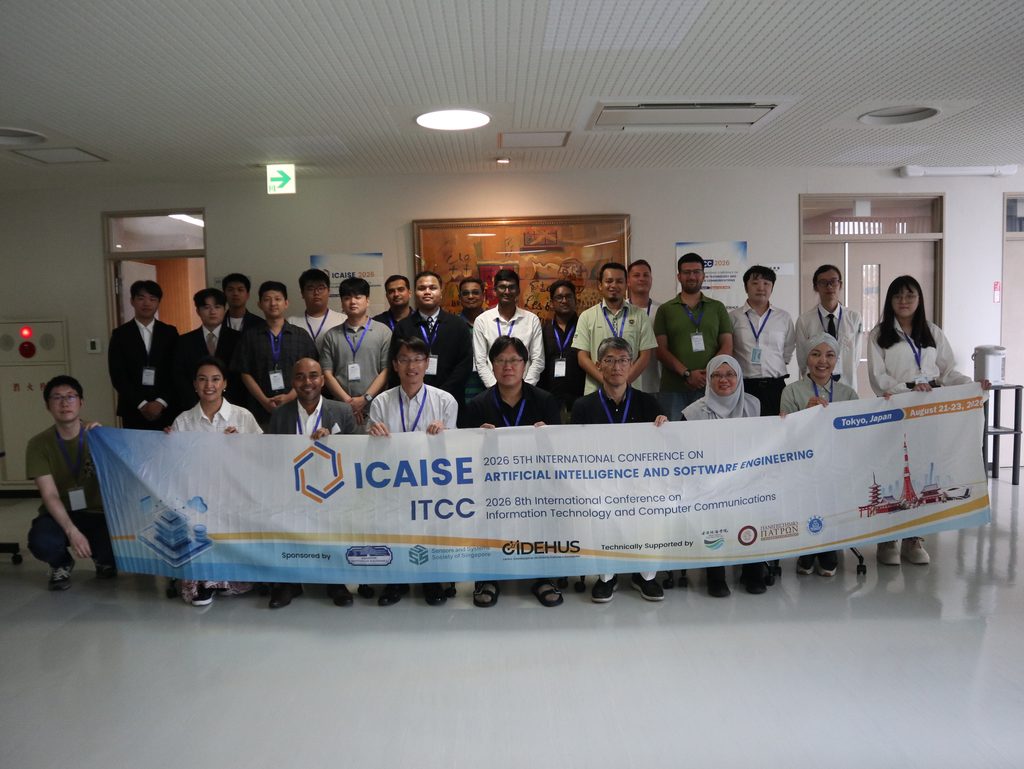
Before the conference wrapped up, all of us presenters and attendees gathered for a group photo — a nice way to mark the end of three packed days of talks, questions, and new connections. It’s always a good feeling to look back at a photo like that and put faces to the researchers and ideas that made the event memorable.
Reflections
This experience allowed me to share my work with a broader research community and gather valuable feedback that will directly shape the next phase of my research. Presenting alongside researchers from different universities across Japan, and fielding questions that pushed me to think more critically about the limitations and future direction of my framework, made this one of the most rewarding parts of my Master’s journey so far.
Acknowledgments
I would like to thank my supervisor, Professor Takahiro Koita, for his continued guidance throughout this research and for encouraging me to present this work at ICAISE 2026. I’m also grateful to Akihito Kohiga, co-author on this paper, for his technical insights during the development of the framework. This opportunity would not have been possible without their support.
The Journey to Tokyo
I booked APA Hotel in Shinjuku for the trip, which turned out to be about 40 minutes from the University of Electro-Communications in Chofu. The hotel was incredibly convenient — easy access to the trains, and a comfortable base for the busy few days of the conference.
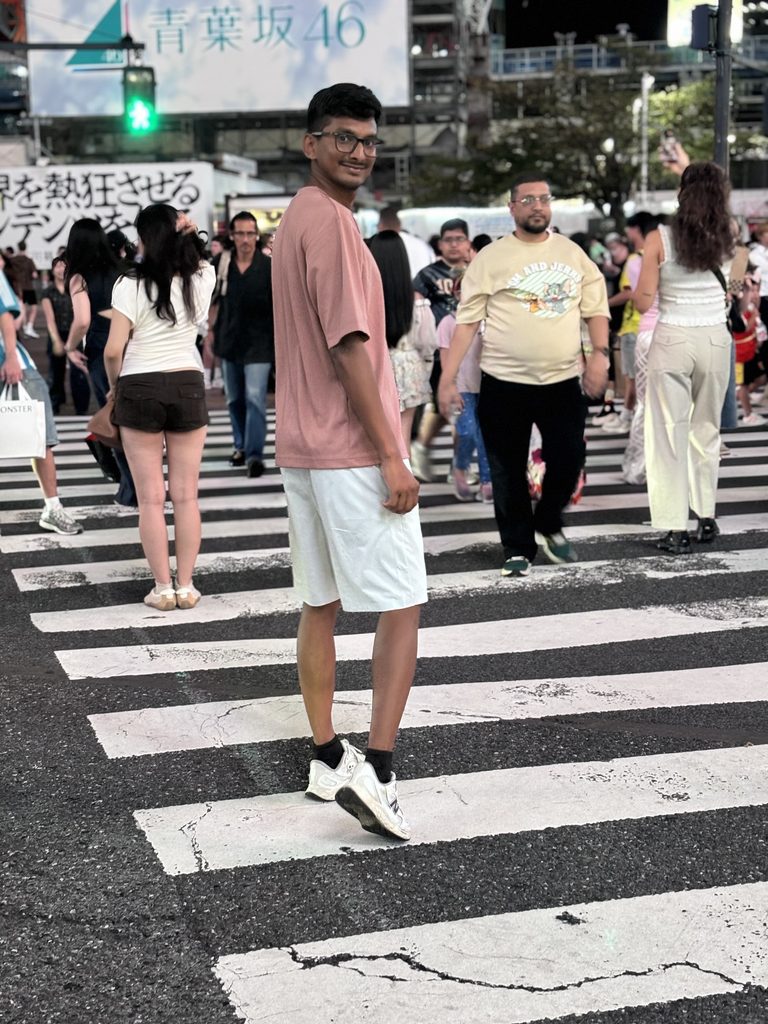
One evening after a long day at the venue, I made time to visit Shibuya Crossing. Seeing it lit up in the evening, with the crowds flowing in every direction, was easily one of my favorite moments of the whole trip.
Thank you as well to everyone at Doshisha University and the Network Information Systems Laboratory for their constant support throughout this research, and to everyone at ICAISE 2026 — the organizers, fellow presenters, and everyone who took the time to ask questions and share feedback. It truly made this experience special.